


Last Updated on 3 December 2025 by Ariana Svenson
Wondering where to spot the best wildflowers in Perth? Look no further!
Growing up in Perth, wildflowers were always part of my life, and part of the rhythms and seasons. We’d head out in late winter and early spring to explore and discover the amazing WA wildflowers. For the past few years, we’ve headed out around Perth and south to discover the amazing wildflowers of Western Australia.
The good news is that even if you don’t travel further than Perth, you can see some amazing Perth wildflowers. In fact, if this is your first visit to see the wildflowers, I’d definitely head to Kings Park! It will give you an excellent orientation and introduction to the flowers. It will make your forays out into the countryside so much more interesting!
We pride ourselves on only covering places we have been or plan to go soon. We’ve researched them thoroughly and in an original way.

When to See the Perth Wildflowers
Wildflower season in Perth runs from late winter to early spring (late August through to October), bringing bursts of colour across the region. Timing can vary slightly each year depending on rainfall, but early spring usually offers the best displays. If you are travelling from overseas or interstate, I don’t think you would be far wrong if you planned for a mid-September trip.
When I was a kid, we’d notice the blooms on the roadsides, we would smell the air, and literally there would be a fragrance in the air that would let you know that the flowers were blooming.
These days I tend to watch social media to see what people are publishing before making firm plans, but of course as a local, its much easier for me to plan a quick day trip to a wildflower hotspot.

The Best Places to See Wildflowers in Perth, WA
Perth sits right on the edge of the South West biodiversity hotspot, one of the most unique ecosystems on the planet. This means an astonishing variety of wildflowers, many of which grow nowhere else in the world, thrive right on the city’s doorstep.
What makes Perth even more special is the way so much of this bushland has been protected. Despite being home to more than 2 million people, Greater Perth still shelters both large conservation areas and little pockets of remnant bush tucked into suburbs.
There are plenty of places in and close to the city to enjoy WA’s spectacular wildflower season.

Kings Park Wildflowers + WA Botanic Garden
Location: Fraser Ave, Kings Park, WA 6005
Wildflowers to Spot: There are over 3,000 species on display. Look out for kangaroo paws, everlastings, orchids, banksia and Geraldton wax.
There are lovely Everlastings at Kings Park, but my favourite thing is the incredible diversity found in a small area. At Kings Park, I have seen flowers that I have never stumbled upon in the wild, which demonstrates the wide range of blooms you can see.
You’ll find wildflowers scattered throughout the park, but the best places to explore are the WA Botanic Garden, the Bushland Nature Trail, and along Law Walk. Keep an eye out for rarer blooms too, including the Qualup bell and other species featured in the Conservation Garden.
Each year, from the 1st to the 30th of September, iconic Kings Park celebrates a wildflower festival of enormous magnitude.
For a guided experience, why not try this Kings Park Wildflower Festival bike tour?

Everlasting Flowers in Kings Park
Kings Park also has some of the easiest to access displays of Everlasting wildflowers in Western Australia. Their papery texture makes them especially photogenic.
Are Dogs Allowed in Kings Park, WA?
Dogs are welcome in many parts of Kings Park as long as they’re on a lead (no longer than 2 metres), but there are some areas where they’re not allowed, including:
- Federation Walkway
- Rio Tinto Naturescape
- Within 10 metres of all playgrounds.
How we have grouped this post – Perth folk tend to divide their city into three rough zones: North of the River, South of the River and “the Hills” (East of Perth). For ease of reference, we have grouped this post in the same way.
Wildflower Hotspots in Perth – North of the River
North of the Swan River, you’ll find plenty of great wildflower hotspots!
Bold Park
Location: Perry Lakes Dr, City Beach
Wildflowers to Spot: Yellow Calothamnus Sanguineus (Silky‑leaved Blood Flower), Grevilleas, Hibbertias and Spider Orchids.
Perth is so lucky to have so many large chunks of bushland around the city; in this case, Bold Park Botanic Garden is a whopping 437 hectares. This unique environment means you’ll have the chance to spot some rare wildflower species you won’t easily find anywhere else.
There are more than 15km of walking trails here, ranging from short 1km loops to longer 5km bushwalks. Reabold Hill boardwalk is the most popular trail with stunning views of the city and coastline.

Star Swamp (North Beach)
Location: Groat St, North Beach
Wildflowers to Spot: Donkey Orchids, Triggerplants, Banded Greenhoods, Catspaw, Cowslip Orchids, Large Pansy Orchids and Carousel Spider Orchids.
Star Swamp in North Beach is a peaceful urban bushland. This A-Class reserve is home to hundreds of native plant species, including over a dozen orchid species and delicate Pink Fairies. You’ll also spot a variety of native shrubs growing among tall tuart, jarrah, and marri trees.
You’ve got coastal heath, paperbark wetlands and tuart woodland, and in spring, there’s plenty of wildflower variety. This is one of the best spots to go with kids, as there’s a family-friendly walking trail.

Hepburn Heights
Location: O’Leary Rd / 319 Hepburn Ave, Padbury (22km North of Perth CBD)
Wildflowers to Spot: Yellow Hibbertia shrubs, Scented Sun Orchids, Templetonias, Orange Star Flowers, Trigger Plants, pink everlastings, kangaroo paws, Candlestick/Firewood Banksias and bush peas.
Hepburn Heights Conservation Area in Padbury (a northern suburb of Perth) is an important Bush Forever site with nearly 200 native plant species, dominated by Candlestick and Firewood Banksias across 53 hectares.
Along the trails, you’ll find stunning orchids like Spider, Cowslip, and Scented Sun Orchids, as well as Templetonias, Orange Star Flowers, and a sea of yellow Hibbertia.
Access the reserve at the end of O’Leary Road (near Padbury Catholic Primary School), and you can enjoy a peaceful 2.1-kilometre loop trail, with a narrower path up the hill offering even more wildflower variety.
Places to see Wildflowers in Perth – South of the River
South of the River, several excellent bushland reserves offer fantastic wildflower spotting opportunities: Wireless Hill Park, Kensington Bushland, and Brixton Street Wetlands.
Kensington Bushland
Location: Etwell St, Kensington
Wildflowers to Spot: Catspaw, Donkey Orchids, Sun Orchids and Colourful Pea Flowers.
Kensington Bushland is a hidden Perth wildflower treasure tucked away just south of the city centre. Kensington Bushland is not nearly as big as some of the others on the list, but it’s still well worth a visit.
The reserve is the best-preserved remnant urban bushland between the Swan and Canning rivers. There are a lot of tree species here, including the Jarrah, Christmas Tree, Sheoak and banksias.

Wireless Hill Park
Location: 4 Almondbury Rd, Booragoon
Wildflowers to Spot: Red and green Kangaroo Paw, plus native Orchids and Wattles.
Wireless Hill is one of Perth’s best-kept secrets, South of the River. This 38-hectare reserve was once the site of Australia’s first wireless telegraphy station. Thanks to major replanting efforts since 1985, the park now boasts species like Geraldton wax, wattles, grevilleas, and callistemons.
Don’t miss the 700-metre Wildflower Walk that offers views of orchids, green kangaroo paw, and other native plants. There are plenty of bushwalks with ample signage.
Wireless Hill Park offers panoramic views of the city from its lookout. The park is also home to the Wireless Hill Museum, where you can learn about the site’s telecommunications history.

Brixton Street Wetlands
Location: Off Alton St, Kenwick
Wildflowers to Spot: Purdie’s Donkey Orchid, Sundews, Flannel Flowers, Blue Squill and Early Nancy.
Tucked away in Kenwick, the Greater Brixton Street Wetlands is a true botanical jewel and the most diverse Bush Forever site on the Swan Coastal Plain. In fact, this biodiversity hotspot has more plant species than Kings Park!
Set on the flat, seasonally waterlogged Pinjarra Plain at the base of the Darling Range, Brixton Street Wetlands is surrounded by areas mostly cleared for housing and agriculture, making the site all the more remarkable.
Despite its modest size, Brixton Street Wetlands supports over 500 native plant species, including more than 80 that are rare, endangered, or recently discovered. Highlights include a wide range of orchids, flannel flowers, feather flowers, blue squill, and carnivorous sundews.

Perth Hills Wildflowers – Some of the Best Wildflowers Near Perth
The Perth Hills are one of the best spots to chase wildflower season close to the city, with colourful blooms scattered across bush trails, lookouts, and national parks. All of these places are just a short drive away from Perth.
John Forrest National Park (Off the Great Eastern Hwy)
Location: National Park Western Entrance, Great Eastern Hwy, Hovea
Wildflowers to Spot: Blue Leschenaultia, Banksias, Wattles, Dryandras, Myrtles, and Kangaroo Paws.

As Western Australia’s first national park, John Forrest is a favourite for spotting wildflowers in the Perth Hills. Just 30 minutes east of Perth, its mix of jarrah and marri forests and heathlands provides the perfect setting for more than 500 species of native flora.
Unlike a few small trails on the list, this is a huge national Park and has lots of different trails. This is a full-day outing, so pack a picnic.
Walking paths like the National Park Falls Walk to the longer Eagle View circuit offer plenty of opportunities to take in the blooms along with waterfalls, streams, and sweeping views of the Darling Scarp.

The ‘Zig Zag’
Location: 1 Zig Zag Scenic Dr, Gooseberry Hill, WA 6076
Wildflowers to Spot: Wattles, Blue Leschenaultia, Kangaroo Paws, and Everlastings.
The Zig Zag Scenic Drive in Gooseberry Hill National Park is a local favourite for wildflowers and sweeping views over Perth. Once a railway line, the winding road now makes for a fun drive, but it’s even better on foot or by bike in spring when the wildflowers are out.
There’s often some confusion about whether the Zig Zag is open or closed because of antisocial behaviour, but as of now, it’s definitely open and worth the trip.
The road is open to cars daily from 11:00 am to 8:30 pm (and yes, if you’re still inside after hours, your car gets locked in overnight). Outside of those times, it’s all yours to walk or cycle. Walking lets you slow down and actually spot different species of wildflowers along the way.

Walyunga National Park (off the Great Northern Hwy)
Location: Walyunga Rd, Upper Swan, WA 6069, 35 km NE of Perth
Wildflowers to Spot: Hakeas, Grevilleas, Isopogons, Petrophiles, Verticordias, Triggerplants, Dryandras, Wattles, Hibbertias, Banksias, and Native Orchids (including Cowslip and Red Fire varieties).
Tucked away where the Avon River meets the Swan, Walyunga National Park, this 1,800-hectare park comes alive with wildflowers during winter and spring.
Trails range from the easy Aboriginal Heritage Trail (1.6 km) along the river to the more challenging Echidna Trail(11 km). The Kingfisher Trail (6 km) is another excellent option, following the river to Syd’s Rapids and passing plenty of wildflower displays along the way.
Entry is via the Great Northern Highway. Gates are open daily from 8:00 am to 5:00 pm, and standard national park fees apply. No dogs are allowed.
Bungendore Park (off the South Western Hwy)
Location: 45 Soldiers Rd, Roleystone, WA 6111 (near Armadale)
Wildflowers to Spot: Banksias, Parrot Bush, Donkey Orchids, Triggerplants, Colourful Pea Flowers, and Jarrah–Marri Understorey Shrubs.
A real gem near Armadale, Bungendore Park is a well-loved local spot for bushwalking and wildflower hunting. This 498-hectare bushland reserve is on the edge of the Darling Scarp, just a few minutes from Armadale. Its mix of soils and landscapes supports more than 300 plant species, from Jarrah–Marri forest to colourful understorey shrubs and orchids.
You’ll find a network of well-marked loop trails that make it easy to explore. The Cockatoo Circuit (1.7 km) is perfect for a quick spring orchid walk, while the Spinebill Stroll (3.5 km) offers an easy loop through the forest and Parrot Bush.
For something longer, the Honeyeater Hike (7.7 km) is considered one of the top trails in the Perth Hills.

Ellis Brook Valley Reserve + Sixty Foot Falls
Location: Ridge Hill Grove, Piara Waters, WA 6112
Wildflowers to Spot: Donkey Orchids, Blue Fairy Orchids, Fuchsia Grevillea, Prickly Dryandra, Yellow Buttercups, Couch Honeypot, Two-Leaf Hakea, Blue Stars, Woolly-Flowered Grevillea, Lemon-Scented Sun Orchids, and Pincushion Coneflowers.
Ellis Brook Valley, in the suburb of Martin, is one of the top wildflower hotspots with more than 550 species of flowering plants. It’s also home to Sixty Foot Falls, a seasonal waterfall that puts on a show after winter rains. This waterfall is also one of the top waterfalls near Perth to visit, as well as being named one of the top waterfalls in WA!
The Sixty Foot Falls Trail (2.1 km) is a short but steep loop that takes you past old quarries, up to the falls, and on to sweeping views of Perth and the valley below. If you’re after something gentler, the Blue Wren Ramble (1.4 km) follows Ellis Brook through Wandoo woodland, perfect for spotting various species of wildflowers and birdlife at a slower pace.

Lesmurdie Falls
Location: Falls Rd, Lesmurdie, WA
Wildflowers to Spot: Dryandras, Yellow Buttercups, Grevilleas, Sticky Starflowers, Morning Irises, Couch Honeypots, Pincushion Hakeas, Pink Enamel Orchids, Sundews, and Triggerplants.
Another excellent option is the Lesmurdie Falls, offering fabulous views of Perth city, an incredible waterfall, and lots of wildflowers in season.
Lesmurdie Falls is one of the Perth Hills’ most spectacular waterfalls and a favourite wildflower spot in spring. Its location on the Darling Scarp means plenty of diverse plant life, and several trails make it easy to explore.
The Valley Loop Trail (3 km) offers a longer walk through varied terrain, while the Foot of the Falls Trail (2 km return) takes you right to the base of the waterfall. For an easy, family-friendly option, the Lesmurdie Brook Loop (1.5 km) follows the brook and has plenty of seasonal blooms.
As always, remember to stick to the marked paths to help protect the area from dieback disease.
For full descriptions of these walks, including length and difficulty, please take a look at A Guide to the Best Perth Waterfalls. Have you visited Quinninup Falls yet? They are stunning, with breathtaking views and fantastic trails to explore.

Serpentine River National Park
Location: Serpentine Falls Rd, Serpentine, WA 6125.
Wildflowers to Spot: Spider Orchids, Greenhood Orchids, Triggerplants, Giant Sundews, Dryandras, Grevilleas, Wattles, Hakeas, and Banksias.
Heading in the opposite direction is the Serpentine National Park, with its incredible waterfalls and beautiful bushland. The park is known for its granite outcrops, jarrah and wandoo forests, and the picturesque Serpentine Falls. In spring, the area is filled with wildflowers.
The Baldwins Bluff Trail (6 km return) will take you past loads of native flora along the granite slopes. Meanwhile, the longer Kitty’s Gorge Walk Trail (14 km return) follows Gooralong Brook and the Serpentine River for a more challenging but rewarding wildflower hike.
If you’re after something easier, the short Serpentine Falls Walk Trail takes you from the car park to the falls, with blooms to spot along the river and picnic areas.

Day Trips from Perth for Spotting WA Wildflowers
All of these wildflower spots near Perth can be done as a day trip from Perth, but for a more relaxed trip, I recommend an overnight stay.
Map of wildflower day trips from Perth:
Dwellingup (Combine with a Visit to Serpentine Falls)
Distance from Perth: 102.6 km
Wildflowers to Spot: Yellow and Pink Feather Flowers, Red Bottlebrush, Lemon-Scented Myrtle, and Rare Orchids.
One of our favourite conservation areas is Lane Poole Reserve. It has an old-growth forest of Jarrah, Marri, and Wandoo Woodlands. We visited in late September, and there was still a range of wildflowers blooming, so this is a good spot for Perth wildflowers.
Both the Bibbulmun Track and the Munda Biddi trail run through Dwellingup!
If you like, you can stop at Serpentine National Park on the way to see Serpentine Falls. Trails here have some incredible seasonal wildflowers and give a taste of the Darling Scarp landscape before heading on to Dwellingup for a relaxed afternoon in the forest or a coffee in town. We love Dwellingup for a short weekend getaway from Perth, and have listed in detail all our guide to our favourite Things to do in Dwellingup.
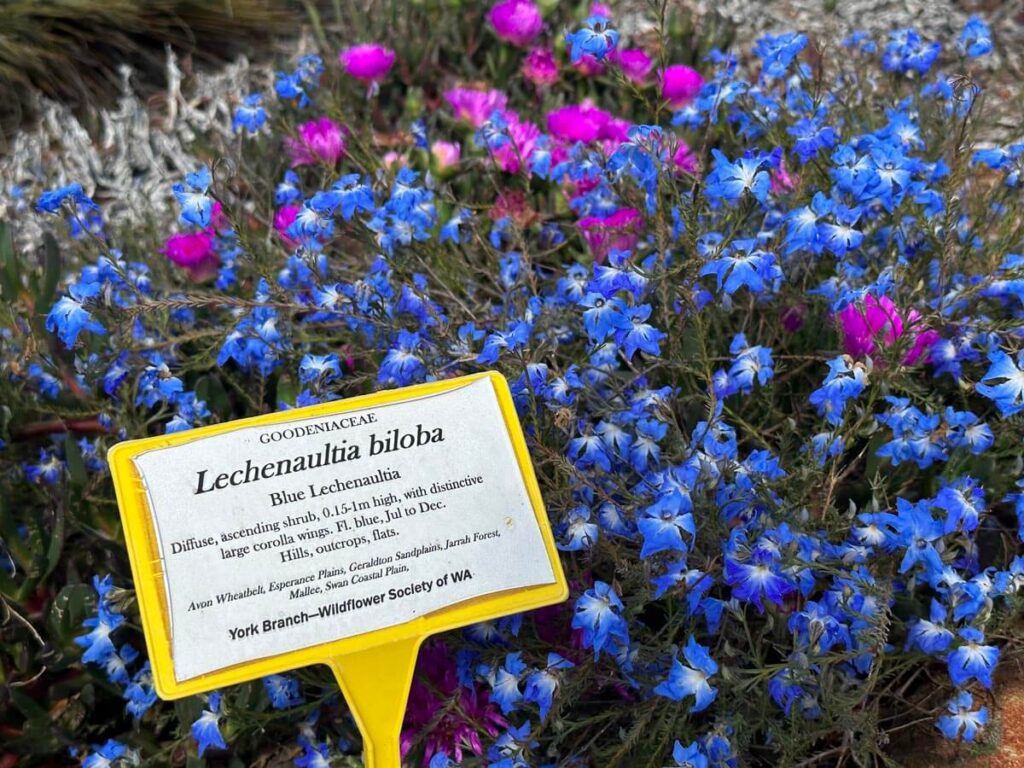
Avon Valley, Including Toodyay and York
Distance from Perth: 62-89 km northeast of Perth
Wildflowers to Spot: Orchids, Hakeas, Grevilleas, Everlastings, Kangaroo Paws, and Wattles.
Start your morning at Avon Valley National Park and take the Avon Valley Loop to see the native orchids, hakeas, grevilleas, and everlastings.
Next, head to Toodyay, a historic town surrounded by rolling hills and woodlands (perfect for wildflowers!). Take short walks on trails or explore nearby bushland to see orchids and wattles in bloom.
Then, finish the day in York, Western Australia’s oldest inland town. The surrounding hills and riverbanks are full of seasonal wildflowers, and easy trail walks around town let you explore the blooms while you enjoy the heritage streets and scenic views. If you’re visiting York, make sure you read our full guide to things to do in York.
Note, while Canola is not a native wildflower, in Spring it fills the countryside with miles and miles of yellow flowers. The area around Toodyay and York is particularly impressive and very photogenic!

Wongan Hills
Distance from Perth: 174 km northeast of Perth
Wildflowers to Spot: Donkey Orchids, Vanilla Orchids, Cowslip Orchids, Leek Orchids, Verticordias (Featherflowers), Pink Grevilleas (Pokers), Dampieras, Hibbertias, Myrtles, Kunzeas, and the rare Wongan Triggerplant.
Wongan Hills is a wildflower paradise in WA, especially in spring. There are over 1,200 varieties of wildflowers. Gathercole Reserve and Reynoldson’s Reserve are especially good. The latter hosts the Reynoldson Reserve Festival Weekend at the end of the season.
You can drive up via Toodyay for a scenic route, or drive through Chittering and Bindoon. If I were going to go to Wongan Hills as a day trip, it’s about 4 hours return driving, and you go through some awesome wildflower spotting places, like Calingiri. And you can’t really get to that area without at least stopping in New Norcia and soaking in the atmosphere.
For overnight stays, consider The Toodyay Hotel if stopping in Toodyay, the unique New Norcia Monastery Guesthouse, or the Farmers Home Hotel or Dukes Inn in Northam (more Northam accommodation recommendations in our Northam, WA guide here.
Or why not stay at the Boshack Farm in Bolgart so you’re in between Toodyay and Wongan Hills? note, Boshack only offers a board and activities option at the moment, so might not suit if you are on a wildflower tour.

Moore River National Park
Distance from Perth: 118 km north of Perth
Wildflowers to Spot: Banksias, Kangaroo Paws, and Everlastings.
Moore River National Park is a 90-minute drive from Perth. Moore River is getting a bit too far out to be a comfortable day trip from Perth. I’d probably try to include Gingin and Yanchep for a fun weekend with minimal driving.
Within the park, the Silver Creek Trail is a standout. This easy 1.3-kilometre return walk winds along the creek and showcases a dense variety of seasonal blooms within the native bushland. It’s perfect for a short walk or a picnic stop while exploring the park.
If you want to take your time and stay overnight, the Guilderton Holiday Park or the Beermullah Shearing Shed are both excellent options.

Perth Wildflower Tours
If you prefer to let someone else do the planning, there are plenty of Perth wildflowers tours that run from late winter through spring to some incredible wildflower hotspots. These range from half-day trips exploring the Perth Hills to multi-day guided adventures.
Some even include morning tea or a winery stop (yes, please!). Make sure to book early during peak season, as spots can fill up quickly, especially in September.
Here are some of the top options:
- Perth Tiny Tours: Offers bespoke wildflower tours by metro, country road trips and even 3-day tours. More info here.
- Off The Beaten Track WA: They run a fantastic Perth waterfalls, wildflowers and Wandoo hiking experience! Find availability here.
- Go Active Tours: A bike tour of Kings Park during the Wildflower Festival. Find availability here.
- Great Western Coach Tours: A small group tour visiting wildflower locations near Perth, including Morning tea and lunch in bushland settings, and a visit to a local orchard. More info here.
- Perth Birds & Bush: Half-day or full-day wildflower tours from Perth or Fremantle. More info here.
- Australian Pinnacle Tours: The top option is this Wave Rock, Wildflowers and Aboriginal culture day tour from Perth! Find availability here.

Final Words: Wildflowers Perth, Western Australia
If you don’t want to leave Perth, you don’t need to travel to see incredible WA wildflower displays. The wildflower spots in Perth and nearby are easily accessible and highly diverse.
If you’re keen to travel further afield, there are amazing wildflower spots in the Perth Hills and further afield, perfect for a day trip or a weekend getaway. In short, if you take the North West Coastal Highway away from Perth, you are going to see some beautiful flowers on the coastal plains.
If you want to visit the best wildflower spots in WA, make sure you also read our guide to wildflowers in Western Australia.


Leave a reply